Thursday, 13 November 2014

Farrant's Prison Correspondence to Seán Manchester


 Missing words from the dog-eared and worn top of the second page are:

"... speak  for  me. I  don't  know  if  they  have ..."


Reproduced above is a letter on headed prison notepaper from David Farrant, now calling himself “A D Farrow” (a pseudonym adopted by him when arrested at midnight by police in Highgate Cemetery on 17 August 1970), to the president of the British Occult Society, Seán Manchester.

David Farrant’s (aka "Allan David Farrow") prison correspondence completely contradicts later claims made by him about his relationship with Seán Manchester and indeed the British Occult Society. It is quite obvious he was in awe of Seán Manchester and sought his assistance. It is also glaringly obvious from this correspondence that Farrant held no membership or association with the British Occult Society.

Written three days before it was posted on 21 August 1970 from Brixton Prison where he was being held on remand for psychiatric reports, Farrant’s own statements leave no doubt where he stood in relation to what was happening. The psychiatric reports would prove inconclusive. It could not be agreed whether he was sane or not. He was nonetheless judged fit to appear in court.

According to the scores of tracts and pamphlets self-published by Farrant from 1991 until the present-day, he now claims to have “founded” the British Occult Society in 1967, and by 1970 his “investigations” were supposedly three years old. This is clearly not the case when reading his prison correspondence of August 1970.

Farrant’s letter explains that his arrest was the result of not listening to Seán Manchester's public warning to him and others engaged in similar behaviour to not interfere with the ongoing investigation being carried out by the British Occult Society. Farrant then claims to have information about a cult meeting in Highgate Cemetery. This did not prevent him entering it with a cross and stake, however, which he overlooks mentioning. He apparently wanted “to find some further evidence of [the cult’s] existence.” He admits going against the wishes of the Society and Seán Manchester. He then promises to forward all the facts about his lone escapade; something he apparently did not do.

Farrant reveals that he has now changed his plea to the court from one of guilty to not guilty, and requests Seán Manchester's appearance as a character witness to speak on his behalf. He expresses concern over how the court might react when they realise he sought publicity in connection with Highgate Cemetery over the six months prior, and now wants Seán Manchester in court “to say you have warned people” about the very behaviour he had engaged in. He claims to appreciate that Seán Manchester is “a busy man,” but nonetheless would like Seán Manchester to visit him, or, at least, send somebody else.

He then asks for Seán Manchester's advice, concluding his letter with the following statement: “Well that’s all, please forgive me for being in this trouble and having to ask your help. I would be grateful if you could write immediately.” Seán Manchester did not write, nor did he allow himself to be exploited for Farrant's court case with the inevitable media coverage to follow, but he did visit Farrant at Brixton Prison. This was the only time Seán Manchester ever visited Farrant in prison and the prison letter written by Farrant and sent on 21 August 1970 was the only correspondence from jail that Seán Manchester has ever received from this man.

The visit left Seán Manchester in absolutely no doubt that Farrant was trying to rope him into some sort of dubious attention-seeking scheme, and that Farrant wanted it to be made all the more plausible by what might be seen as Seán Manchester's seal of approval. Farrant was told in no uncertain terms that it was not going to happen. The court case against Farrant on this occasion was dismissed because Highgate Cemetery, in the strict sense of the wording of the charge, is not an enclosed area, and Farrant had been accused of being found in an enclosed area for an unlawful purpose. Thereafter compulsive publicity-seeker Farrant continued to seek attention and make a general nuisance of himself.


David Farrant's prison correspondence was sent to an address in Archway Road.
It was duly forwarded to Seán Manchester whose address Farrant did not know.

Wednesday, 12 November 2014

Seán Manchester's comment on David Farrant


The first meeting with David Farrant at Highgate Cemetery took place in early March 1970.


Seán Manchester's comment on David Farrant from his Memoir:

David Farrant (born 23 January 1946) posted on his blog, 2 July 2009: "I first met [Seán Manchester] in late 1967 in a pub called the Woodman in Highgate." However, on the same blog one week later, 9 July 2009, he claimed: "You asked how I first actually spoke to [Seán Manchester] ... I believe it was in early 1969." The year would fluctuate according to whatever fantasy Farrant was in the process of dreaming up. He managed in later decades to conveniently slips all manner of unsubstantiated allegations into this three years discrepancy. Some of these are truly bizarre, but I digress. What first brought this man to my attention was his letter published in the Hampstead & Highgate Express, 6 February 1970: 

"The first occasion was on Christmas Eve. ... The second sighting, a week later, was also brief. Last week, the figure appeared, only a few yards inside the gates. ... I have no knowledge in this field and I would be interested to hear if any other readers have seen anything of this nature."

Pages 62-63 of my concise vampirological guide, The Vampire Hunter’s Handbook, reveal:

“His alleged sightings of the vampire were to coincide with the time when he was ensconced in [Tony Hill’s] coal cellar. His wife was gone and so were the people who had helped him squander his money [a small inheritance of slightly more than £6,000]. His interest was not the occult at this time, but pub-crawling and the collecting of exotic birds; mostly cockatoos, parrots and macaws. This earned him the nickname ‘Birdman.’ Ironically, Hill had the nickname ‘Eggman.’ Relishing the attention he was now receiving, following his alleged sightings of a vampire, he took foolish risks and ended up being arrested in August 1970 for being in an enclosed area for an unlawful purpose. His ‘vampire hunting’ days were over.”

The Hampstead & Highgate Express, 6 March 1970, records the first meeting between us on its front page, under the banner headline “Why Do The Foxes Die?” The newspaper recounts:

“David Farrant … returned to the spot last weekend and disovered a dead fox. 'Several other foxes have also been found dead in the cemetery,' he said at his home in Priestwood Mansions, Archway Road, Highgate. 'The odd thing is there was no outward sign of how they died. Much remains unexplained, but what I have recently learnt all points to the vampire theory being the most likely answer. Should this be so, I for one am prepared to pursue it, taking whatever means might be necessary so that we can all rest.' The vampire theory was suggested last week by Mr Seán Manchester, president of the British Occult Society. … Mr Farrant and Mr Manchester met in the cemetery at the weekend.”

The British Occult Society (1860-1988) was an investigation bureau which existed solely for the purpose of examining occult claims and alleged paranormal activity. It gave birth on 2 February 1970 to the Vampire Research Society, which still survives, as does a remnant of ex-members of the British Occult Society. Farrant carried out his threat to "pursue [the vampire], taking whatever means might be necessary" and was arrested on the night of 17 August 1970. The Daily Express, 19 August 1970, reveals his stated explanation:

"‘My intention was to search out the supernatural being and destroy it by plunging the stake [found on him when arrested in the graveyard, along with a wooden cross] in its heart.’" 

The report continues: 

"David Farrant pleaded guilty at Clerkenwell, London, to entering St Michael's churchyard, Highgate Cemetery, for an unlawful purpose. Farrant told police he had just moved to London when he heard people talking about the vampire in Highgate Cemetery. In a statement he said that he heard the vampire rises out of a grave and wanders about the cemetery on the look-out for human beings on whose blood it thrives. Police keeping watch for followers of a black magic cult arrested him. He was remanded in custody for reports. Last night, Mr Seán Manchester, leader of the British Occult Society, said: ‘I am convinced that a vampire exists in Highgate Cemetery.’"

The eminent paranormal researcher Peter Underwood would comment in a book published five years after Farrant had launched his attention-seeking career: “Publicity of a dubious kind has surrounded the activities of a person or persons named Farrant and his — or their — association with Highgate Cemetery. … a Mr Allan Farrant was caught climbing over the wall of Highgate Cemetery carrying a wooden cross and a sharpened piece of wood. … According to the Daily Mail Allan Farrant saw ‘an apparition’ eight feet tall in the cemetery that ‘just floated along the ground’ when he was on watch one morning waiting ‘for the vampire to rise.’ He believed that there had been a vampire in Highgate Cemetery for about ten years. … Less than a month later a Mr David Farrant was guiding Barry Simmons of the London Evening News on a night-tour of Highgate Cemetery armed with a cross and wooden stake which he carried under his arm in a paper carrier bag. In fact the whole project seems to have been a somewhat dismal and depressing effect — even the cross, created from two pieces of wood, was tied together with a shoelace.” [The Vampire’s Bedside Companion by Peter Underwood, Leslie Frewin Books, 1975, pages 77-79.]

Readers letters to the Hampstead & Highgate Express in early 1970 included reports of a ghost wearing a top hat that had been seen in Swains Lane, just inside the north gate at Highgate Cemetery. With the benefit of hindsight we now know that some of these letters bore the names and addresses of close acquaintances of Farrant. Fraudulent letters were sent to the Hampstead & Highgate Express, 13 February 1970, using the names and addresses of Farrant's friends Audrey Connely and Kenneth Frewin. He used these names and addresses with their consent. He used his close friend Nava Grunberg's address in Hampstead Lane, but her name was changed to a pseudonym. He also used Nava Grunberg, now adopting the nom de plume "Nava Arieli." She used an address in Rosslyn Hill, Hampstead, belonging to a friend of hers. Others might have witnessed Farrant in his familiar black mackintosh pretending to be a ghost. He wore an old grey topper and ghostly make-up to convince local people that the cemetery was haunted by a “ghost.” The vampire sightings and experiences by others were probably genuine enough. He was not. Farrant's part in the saga was fraudulent. He pretended to be a "vampire hunter" for the next few months before turning his attention to malefic pseudo-occultism which guaranteed a far bigger return in the publicity stakes. This led to criminal convictions which included indecency in Monken Hadley churchyard under the Ecclesiastic Courts Jurisdiction Act 1860. Victoria Jervis was also found guilty. Her revelations under oath when called as a witness during Farrant's Old Bailey trials two years later are damning, to say the least. This is what she stated under oath: 

"I have tried to put most of what happened out of my mind. The false letters I wrote to a local paper were to stimulate publicity for the accused. I saw him almost every weekend in the second half of 1972 and I went to Spain with him for a fortnight at the end of June that same year. I was arrested with him in Monken Hadley Churchyard. That incident upset me very much. Afterwards, my doctor prescribed tranquilisers for me." 

Facing Farrant in court to address him, Victoria Jervis added: 

"You have photographed me a number of times in your flat with no clothes on. One photograph was published in 1972 with a false caption claiming I was a member of your Society, which I never was." 

On another occasion, she recalled, how she had written psuedonymously to a local newspaper at Farrant's request "to stimulate publicity for the accused."

During their case where Jervis and Farrant were both found guilty of indecency in Monken Hadley churchyard, "Mr P J Bucknell, prosecuting, said Mr Farrant had painted circles on the ground, lit with candles, and had told reporters and possibly the police of what he was doing. 'This appears to be a sordid attempt to obtain publicity,' he said." (Hampstead & Highgate Express, 24 November 1972).

Things began to spiral downwards at an alarming rate as he turned to what ostensibly appeared to be diabolism, but in truth was just further attention-seeking for the sake of the media. He nonetheless engaged in theatrical stunts of an occult nature in churchyards, cemeteries, woods and derelict houses which took on an increasingly satanic appearance. This led to him being charged, tried and convicted for offences which included malicious vandalism to tombs, interfering with and offering indignity to remains of the dead through the use of black magic, and attempting to pervert the course of justice by threatening police witnesses with death dolls impaled with pins. By which time I decided to get to know him properly for the purpose of discovering exactly what was going on and try to and resolve whatever lay behind the enmity evinced toward me by this man. This was some time after Farrant had invited what he describes as a "satanic force" to enter him in a nocturnal necromantic ritual he claims to have staged with a naked female at Highgate Cemetery in 1971. The ritual is described at length by Farrant in an article he wrote while serving a four years’ eight months’ prison sentence. It was published in the fourth issue of New Witchcraft magazine. 

In another article called "Witch Report," (Penthouse magazine [UK], Vol. 8, No. 8, 1973, page 19), he mentions helping a man of diminutive stature — "a midget" — who was being evicted from a controlled tenancy and allegedly suffered harassment as a consequence. Furthermore, the man's wife was apparently pregnant and not coping with the stress of the situation. Farrant "wrote to the landlady saying politely but bluntly that if she didn't stop we would deal with her our own way." She was sent an amulet "consecrated"by Farrant along with a rhyme intended to convey that "once she'd touched it we'd have power over her, and we performed a ceremony in which we cast forces on her wishing her all she wished on the midgets."  Two days later, according to Farrant, "she went into the hospital and lost her baby." 

In that Penthouse article, Farrant states: "Satanists worship Lucifer, the supreme power of evil, whereas witchcraft is a neutral thing — it's only evil if practised for an evil purpose." Like several of his Luciferian acquaintances, Jean-Paul Bourre amongst them, David Farrant, who publicly stated that he abandoned witchcraft in 1982, describes himself as someone who “accepts Lucifer as an important deity” and that he “worships Lucifer.” His words are heard on The Devil’s Fool CD (Gothic Press) which comprises thirty-two interview extracts of this individual from as many years of his infamous career as a publicity-seeker.

The person I came to know believed only in his own self-aggrandisement and the amount of newsprint his manufactured stunts might attract; a man, moreover, who did not believe in his own rectitude. So, rather than resolve anything, my acquainting myself with Farrant only served to make matters worse because he understood that I was someone who had become all too aware of his insincerity and deceitfulness. That notwithstanding, I have not ruled out the possibility that his engaging in theatrical Satanism and phoney witchcraft to stimulate media interest might have helped him become possessed by something demonic in the process.

My final contact with David Robert Donovan Farrant is recorded in From Satan To Christ (1988), which publication discusses the occult explosion in London in the preceding decades. My first mention of him is found in the British Occult Society edition of The Highgate Vampire (1985) where, on page 81, I observe that, albeit "something of a nuisance to people," Farrant's woes are entirely "self-inflicted." Others went further, of course, describing him as "crazy" (Canon John Pearce Higgins, Daily Express, 26 June 1974) and "truly evil" (Dennis Wheatley, Daily Express, 26 June 1974), but I shall leave the last view of Farrant, based on personal acquaintance, with paranormal researcher Andy Pryce of Birmingham who, on 19 February 2001, wrote the following statement:

“I have spent most of my life studying accounts of vampirism, and have indeed visited Highgate Cemetery on numerous occasions. How it has changed over the years! I am interested in research into any accounts of actual vampirism, from the writings of Dom Augustine Calmet through to modern day accounts. I have a copy of The Highgate Vampire which I found very interesting. I remember the events at the time they happened and the various newspaper reports. It was then that I first came across the name ‘David Farrant.’ I met him once in a pub near Highgate and found him to be a compulsive liar and there was something shifty about his mannerism. I have since warned many people to stay clear of him.”

My own experience echoes that of Andy Pryce. There is something unpleasantly toxic about this mild-mannered, nervous, stammering creature whose stoop, combined with what appears to be an advanced stage of anorexia, immediately puts one in mind of either Rod Hull or Dickens' Uriah Heep.


The sad spectre of David Farrant in a pub at the turn of the century.

Friday, 31 October 2014

The Ghost of Highgate Past


Born in January 1946, David Farrant came to prominence in February 1970 when he wrote a letter to his local newspaper claiming to have had three sightings of a ghostly apparition as he passed by the gates of London's Highgate Cemetery.


Yet, he told Andrew Gough (Arcadia, 12 December 2009); "For a start, my letter to the Ham and High in 1970 badly misquoted myself (not deliberately I concede). I did not say that I had seen the figure (ghost) ‘on three occassions’: I was describing a figure that I said ‘had been seen on at least three occasions’. This is true – it had. But on these occasions, the witnesses were other people whom I had witnessed by this time."

Is it really plausible that Farrant's letter was so monstrously altered by the editor of a highly respectable newspaper to mean something quite different to what he had actually written? Is it likely that Farrant would not have insisted on having such a tampered version corrected in the following week's issue if this had really happened? There is no record of him having asked for any such correction. There is no record of an amendment appearing even though his contact with that newspaper remained extant for the next few weeks. There are records of Farrant sticking with his personal "three sightings" account until October of that year at which point it suddenly reduced to "two sightings." Decades later it became just "one sighting."

This is what David Farrant actually wrote in the Hampstead & Highgate Express, 6 February 1970:

"On three occasions I have seen what appeared to be a ghost-like figure inside the gates at the top of Swains Lane. The first occasion was on Christmas Eve. The second sighting, a week later, was also brief. Last week, the figure appeared, only a few yards inside the gate. This time it was there long enough for me to see it much more clearly."

The next month Farrant stated to Today interviewer Sandra Harris on British television: "The last time I actually saw its face." Does this not suggest there was a time previous to the one he is referring to in that interview? Then there is the BBC's 24 Hours interview transmitted on 15 October 1970. Laurence Picethly’s interview with Farrant for BBC television was sandwiched between footage of the President of the British Occult Society that had been filmed at the society’s north London headquarters and on location at Highgate Cemetery. The man representing the British Occult Society was obviously not Farrant even though the latter would fraudulently adopt that title two years later. In fact, the British Occult Society had distanced itself from everything Farrant was doing as far back as March 1970. The interview Farrant gave in late 1970 is important, however, because there are no editors for him to blame for allegedly "altering" what he alleged. In the 1970 24 Hours programme the words are heard from his own mouth and there is no escaping them.

Laurence Picethly: “On August the seventeenth, Allan [known locally as ‘Allan’ - his correct name being ‘David’] Farrant decided to pay a midnight visit to the cemetery to combat the vampire once and for all. At the cemetery, Farrant was forced to enter by the back wall [footage shows Farrant entering via the rear of the cemetery], as he still does today. He armed himself with a cross and stake, and crouched between the tombstones, waiting. But that night police, on the prowl for vandals, discovered him. He was charged with being in an enclosed space for an unlawful purpose, but later the Clerkenwell magistrate acquitted him. Now, in spite of attempts by the cemetery owners to bar him, Farrant and his friends [no friends were discovered by the police or subsequently identified by Farrant] still maintain a regular vigil around the catacombs in hope of sighting either the vampire or a meeting of Satanists.”

David Farrant: “We have been keeping watch in the cemetery for … [pauses] … since my court case ended, and we still found signs of their ceremonies.”

Laurence Picethly: “Have you ever seen this vampire?”

David Farrant: “I have seen it, yes. I saw it last February, and saw it on two occasions.”

Laurence Picethly: “What was it like?”

David Farrant: “It took the form of a tall, grey figure, and it … [pauses] …seemed to glide off the path without making any noise.”

Farrant's interview ends at this point. It is reproduced above in its entirety. He was acquitted of the charge that had led to his arrest, it being that he was found in an enclosed area for an unlawful purpose. Highgate Cemetery is obviously not “an enclosed area” and that is all he was charged with in August 1970. The BBC report then returned to the President of the British Occult Society who had strongly advised against the behaviour which led to Farrant's arrest on an earlier television programme transmitted on 13 March 1970.


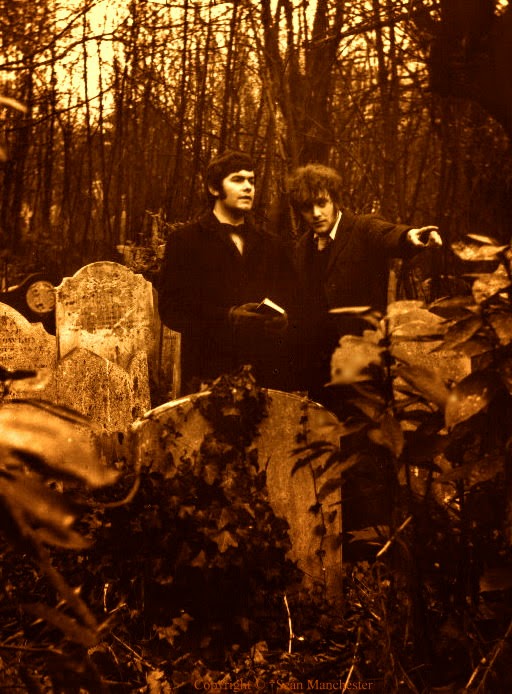
Three things are of significance in that BBC television interview from October 1970. The reconstructed footage of what Farrant was doing on the night of 17 August 1970 clearly shows him hunting a vampire with a rosary around his neck, a large cross in one hand and a sharpened wooden stake in the other hand. There is no ambiguity about what led to his arrest in this report where he is featured reconstructing what he was doing at the time of his arrest around midnight in Highgate Cemetery. The image above is taken from the 24 Hours programme as Farrant went through the motions of the actions which led to his arrest. The second thing of significance is that when Laurence Picethly asked whether Farrant had ever seen the vampire, Farrant did not attempt to correct the person interviewing him by saying it was something other than a vampire. Nor did he say that he did not believe in vampires, or that what he witnessed was not a vampire. Indeed, this section of the 24 Hours programme was titled Vampires. The third thing of significance is that when asked if he had seen the vampire Farrant responded: “I have seen it, yes. I saw it last February, and saw it on two occasions.” He clearly stated that he had two sightings of the vampire in early 1970, but in the interview he gave Andrew Gough he states that he had only one sighting and that this was in December 1969, not February 1970 as stated by him in his BBC television appearance some four decades prior.

Having seen Farrant's letter when it was published in the Hampstead & Highgate Express, Seán Manchester agreed to meet this correspondent at Highgate Cemetery so that Farrant could point out the spot where he allegedly sighted the supernatural phenomenon mentioned in his published letter. Seán Manchester was not impressed by Farrant, a scruffy individual who harped on about potential media coverage of the alleged "ghost" he claimed to have seen. Seán Manchester took the opportunity to warn against antics such as Farrant was considering when he was interviewed on Thames Television's Today programme, 13 March 1970, saying that the investigation of the phenomenon should be left to those who knew what they were doing. In his published letter of 6 February 1970, Farrant proclaimed: "I have no knowledge in this field and I would be interested if any other readers have seen anything of this nature."

Seán Manchester demonstrated on the television programme how such manifestations were traditionally despatched according to folklore and historical cases, many of which involved the clergy. Five months later, ignoring the public warning issued by him that individuals should not take matters into their own hands in this way, Farrant was arrested at midnight in Highgate Cemetery by police who found in his possession a Christian cross and wooden stake. Farrant was alone and claimed to be in pursuit of the legendary vampire said to haunt Highgate Cemetery. Although he originally pleaded guilty, he later changed his plea to one of not guilty after being held on remand at Brixton Prison for the remainder of that month. Charged with being in an enclosed area for an unlawful purpose, he was eventually acquitted and released as Highgate Cemetery does not qualify as being an "enclosed area." The Daily Express, 19 August 1970, reported that Farrant told the police (as read out in court from his statement): "My intention was to search out the supernatural being and destroy it by plunging the stake [found in his possession when arrested by police on the night in question] in its heart. "He later reconstructed what he was doing on the night of his arrest for BBC television's 24 Hours. While inside prison, Farrant had written to Seán Manchester to request support from the British Occult Society to which Farrant owed no connection. He was visited while on remand and told that the Society could not countenance his behaviour. Soon afterwards, Farrant began to falsely associate himself with the BOS, which immediately led to rebuttals appearing in various newspapers. It was only a matter of time before David Farrant began to fraudulently describe himself as the "president of the British Occult Society."


Readers letters to the Hampstead & Highgate Express in early 1970 included reports of a ghost wearing a top hat that had been seen in Swains Lane and just inside the gates at Highgate Cemetery. With the benefit of hindsight we now know that some of these letters bore the names and addresses of friends and acquaintances of Farrant. Phoney letters were sent to the Hampstead & Highgate Express, 13 February 1970, using the names and addresses of Farrant's friends Audrey Connely and Kenneth Frewin. Farrant wrote those letters in order to give his hoax some credibility. He used the names and addresses of friends with their consent. He used his close friend Nava Grunberg's address in Hampstead Lane, but her name was changed to a pseudonym. He also used Nava Grunberg, now adopting the nom de plume "Nava Arieli," when she used an address in Rosslyn Hill, Hampstead, belonging to a friend of hers. Residents and passers-by might have witnessed Farrant in his familiar black mackintosh pretending to be a ghost. It has since been confirmed that he wore an old grey topper and ghostly make-up to convince local people that the cemetery was haunted. Then Farrant heard tales of the legendary vampire in pubs he frequented and decided to board what he perceived to be a publicity bandwagon. The rest is history. The vampire sightings and experiences by others were genuine enough. Farrant was not. His part in the saga was utterly fraudulent. He pretended to be a "vampire hunter" for the next few months before turning his attention to malefic pseudo-occultism which guaranteed a far bigger return in the publicity stakes. This quickly led to criminal convictions which included indecency in Monken Hadley churchyard under the Ecclesiastic Courts Jurisdiction Act 1860. Victoria Jervis was also found guilty. Her revelations under oath when called as a witness during Farrant's Old Bailey trials two years later are damning, to say the least. This is what she said:

"I have tried to put most of what happened out of my mind. The false letters I wrote to a local paper were to stimulate publicity for the accused. I saw him almost every weekend in the second half of 1972 and I went to Spain with him for a fortnight at the end of June that same year. I was arrested with him in Monken Hadley Churchyard. That incident upset me very much. Afterwards, my doctor prescribed tranquillisers for me."

Facing David Farrant in court to address him, Victoria Jervis added:

"You have photographed me a number of times in your flat with no clothes on. One photograph was published in 1972 with a false caption claiming I was a member of your Society, which I never was."

On another occasion, she recalled, how she had written pseudonymously to a local newspaper at Farrant's request "to stimulate publicity for the accused."

Back in 1972 during the indecency case, "Mr P J Bucknell, prosecuting, said Mr Farrant had painted circles on the ground, lit with candles, and had told reporters and possibly the police of what he was doing. 'This appears to be a sordid attempt to obtain publicity,' he said." (Hampstead & Highgate Express, 24 November 1972).

Speaking at the April 1996 Fortean Times Convention, Maureen Speller commented: "The programme came up with ‘His investigations had far reaching and disturbing consequences’ which I said meant he’d been arrested a lot. Strangely enough, this is more or less what he said. God, I felt old being the only member of [my] group who could remember this nutter being arrested every few weeks.” 

“The wife of self-styled occult priest David Farrant told yesterday of giggles in the graveyard when the pubs had closed. ‘We would go in, frighten ourselves to death and come out again,’ she told an Old Bailey jury. Attractive Mary Farrant — she is separated from her husband and lives in Southampton — said they had often gone to London’s Highgate Cemetery with friends ‘for a bit of a laugh.’ But they never caused any damage. ‘It was just a silly sort of thing that you do after the pubs shut,’ she said. Mrs Farrant added that her husband’s friends who joined in the late night jaunts were not involved in witchcraft or the occult. She had been called as a defence witness by her 28-year-old husband. They have not lived together for three years.” (The Sun, 21 June 1974).

“All he talked about was his witchcraft. He was very vain.” (Julia Batsford, an ex-girlfriend quoted in the Daily Mail, 26 June 1974).

"Au pair Martine de Sacy has exposed the fantasy world of David Farrant, self-styled high priest of British witchcraft, for whom she posed nude in front of a tomb. Farrant was convicted last week by a jury who heard stories of Satanic rites, vampires and death-worship with girls dancing in a cemetery. Afterwards, 23-year-old Martine said: 'He was a failure as a lover. In fact, I think his trouble was that he was seeking compensation for this. He was always after publicity and he felt that having all these girls around helped. I'm sure the night he took me to the cemetery had less to do with occultism than his craving to be the centre of something.' ... While Martine told her story in Paris, customers at Farrant's local — the Prince of Wales in Highgate, London — chuckled over the man they called 'Birdman.' One regular said: 'He used to come in with a parrot on his shoulder. One night he came in with photos of Martine in the nude. We pinched one, and when she next came in, we told her he was selling them at 5p a time. She went through the ceiling.' ... Farrant called his estranged wife Mary, in his defence. She said: 'We would go in the cemetery with my husband's friends when the pubs had closed. We would frighten ourselves to death and come out again. It was just a silly sort of thing that you do after the pubs close. Nobody was involved in witchcraft or the occult'." (News of the World, 30 June 1974).

“I cannot believe for one moment that he is a serious student of the occult. In fact I believe him to be evil and entirely to be deplored.” (Dennis Wheatley, Daily Express, 26 June 1974).

“I think he’s crazy.” (Canon John Pearce Higgins, Daily Express, 26 June 1974).


Thursday, 30 October 2014

Forty-four Years On ...


CHAT #44 (30 October 2014, pages 48-49)

Over 44 years since the case went public and still they get it wrong!


Seán Manchester's comment on Natasha Wynarczyk's article:


"I really cannot understand why Chat magazine has to mention me when it gets so much wrong. Natasha Wynarczyk did not contact me and certainly did not quote accurately from my book The Highgate Vampire (which, of course, she does not mention), assumIng, that is, she has ever read it in the first place, which I seriously doubt. Unfortunately, wrong attributions and unnecessary inaccuracies permeate the article from start to finish.

"There is a picture of a crucifix and stake which are part of a vast collection of vampirological accoutrements held by me (the Stock Photo archive would have identified this fact, but Chat magazine did not for some mysterious reason) which was published alongside and across an image of David Farrant who is captioned 'vampire expert' when he is nothing of the sort and, moreover, does not claim any expertise in that subject.

"I am accused of 'decrying' Farrant's 'expertise' which is palpable nonsense. What 'expertise,' one might wonder? Farrant once claimed to be a witch and is nowadays closer to an atheist/agnostic. I am a traditionalist and have always held strong Christian beliefs. As we each subscribe to entirely different belief systems, his modus operandi and mine are entirely different. He does not believe in the existence of vampires, something he makes very clear on his website and in interviews he has given down the years. Yet he is apparently a 'vampire expert.'

"Dates and descriptions of alleged incidents and facts are all over the place in Natasha Wynarczyk's sensationalist article, rendering it no more than entertainment for Hallowe'en, albeit misinforming readers of what really occurred, and little else. I would very much rather future reference to me be omitted, but we know that is just not going to happen. It would be a little difficult in view of the fact that I am the person who led the investigation into the case and finally exorcised the vampiric entity just over forty years ago (not mentioned, of course, in Wynarczyk's article). The bottom line is that I steer clear of publicity, whereas the other fellow does not. Thus Chat is content to cobble together whatever they can lay their hands on without a care for the facts, resulting in the travesty we end up with in Natasha Wynarczyk's article."

Encountering the Undead at Highgate


In his book The Highgate Vampire, Seán Manchester states that the vampiric source of the Highgate infestation first showed up shortly after the infamous vampire plague of the early 1700's, the same era as Arnold Paole and Peter Plogojowitz. He further states that an Eastern European nobleman rented Ashurst House in the early 18th century. This all seems to make sense, and it suggests that Tamás Orszag of Hungary is the most likely candidate for the identity of the Highgate Vampire.


A composite of the Highgate Vampire's appearance can be gleaned from various statements in the Vampire Research Society's archive and, of course, on public record in Seán Manchester's The Highgate Vampire (published by Gothic Press).*


Accounts provided by witnesses in the Hampstead & Highgate Express, 13 February 1970 & 20 February 1970, describe "a most unusual form [that] just seemed to glide across the path ... a pale figure ..."; "Many tales are told about a tall man who walks across Swains Lane and just disappears through a wall into the cemetery ..."; " ... a 'form' moving behind some gravestones ... the thing made no sound and seemed to disappear into nowhere ..." *


Jacqueline Beckwith, a teenager living in North Hill, awoke one night with something icy cold clutching her hand which soon went numb. The next morning revealed "deep tears in the flesh where she had forced [her hand] free." *


A ghost hunter by the name of Thomas told of "a dark shape [which] moved across the path directly in front of us." On an earlier occasion he had started to walk home with his fiancee down the lane running alongside and eventually between Highgate Cemetery. "Something was standing behind the iron railings of the gate ... upon its face was an expression of basilisk horror." *


Once again, "the thing behind the gate appeared to dissolve into the shadows of the night." *


Only when discovered in the putrid chamber of its tomb at Highgate Cemetery in August 1970 do we start to gain an idea of the full extent of the Highgate Vampire's horrific countenance. At its extirpation in the grounds of the neo-gothic derelict mansion in early 1974 the appearance is one of a heavy form, gorged and stinking with blood with eyes glazed and staring horribly, glinting with the red fire of perdition. This great leech possessed sallow, parchment-like skin beneath which a faint bluish tinge could be discerned; the colour of a three-day old corpse. It had black hair and eyebrows that were especially heavy and joined across the bridge of an aquiline nose. The mouth betrayed thin, cruel lips which drew back, almost in a snarl, to reveal sharp teeth where lodged congealed gouts of discolouring blood, the offal of the previous night's feast. Some witnesses describe a tall figure with a hideous countenance. All remark upon the eyes which burned like hot coals in a face so frightening it paralysed them in their tracks. There was also the unbearably fetid stench that accompanied this presence, rank with corruption and the stench of the charnel, which indicated an undead rather than an apparition. The last moments, some of which were captured by a 35mm camera, reveal the same"burning, fierce eyes beneath black furrowed brows staring with hellish reflection. Yellow at the edges with blood-red centres, unlike anything imaginable. Flared nostrils connected to a thin, high-bridged nose. The mouth still set in its cruel expression with lips drawn far back as if unable to contain the sharp, white teeth." *


“A pyre was built in the centre of the large garden … We looked, but saw none of its awful contents before everything was consumed. At last it was hidden from our view ― its dark pestilence swallowed in the bright flames which leaped skyward while all beneath crackled and hissed. Several hours later all that remained was a great scorch-mark on the ground … We stood staring at the charred spot, not daring to believe it was finally over. I took a handful of grey dust from the blackened earth and scattered it to the four winds.” *


* (The Highgate Vampire, pages 49, 54, 65, 66, 67, 68, 85, 86 & 142, 144, 145, Gothic Press edition)

Does a Wampyr Walk in Highgate Today?


The demonic presence in corporeal form (at first known locally and eventually worldwide as the Highgate Vampire) was successfully exorcised in early 1974. While accepting there have been anomalous sightings of apparition-like phenomena down the decades for generations - certainly as far back as Victorian times - none of these in recent years are remotely similar to sightings of what became known as the Highgate Vampire four and a half decades ago. Unfortunately, all the recent claims to a ghostly presence wafting about in the vicinity of the graveyard stem either directly or indirectly from a hoaxer who contacts his local newspapers regularly to such an end when not winding up naïve, local paranormal groups in the area comprising people not even born when events occurred in the 1960s and turn of the 1970s, who are clearly in awe of anything which might connect tangentially to the original case.

The Vampire Research Society has stated that it would not dismiss the possibility of other manifestations elsewhere having a demonic/vampiric source, but no convincing evidence of the same phenomenon as before returning to Highgate Cemetery or indeed any of its environs has been provided by anyone.

The answer, therefore, to the question as to whether a wampyr still walks in Highgate is a resounding no.